No account. No download. The engine runs in your browser.
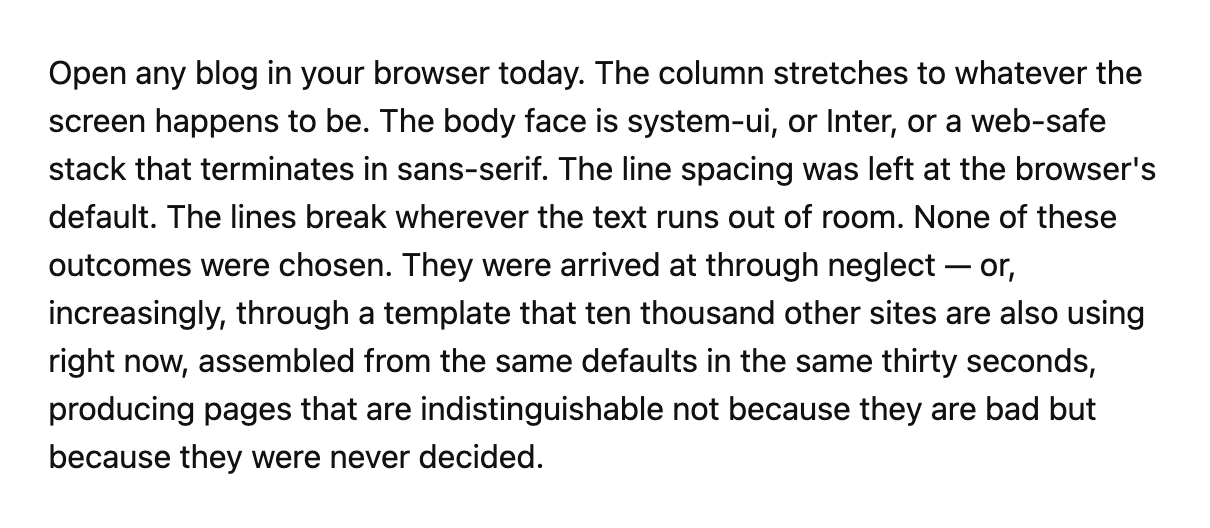
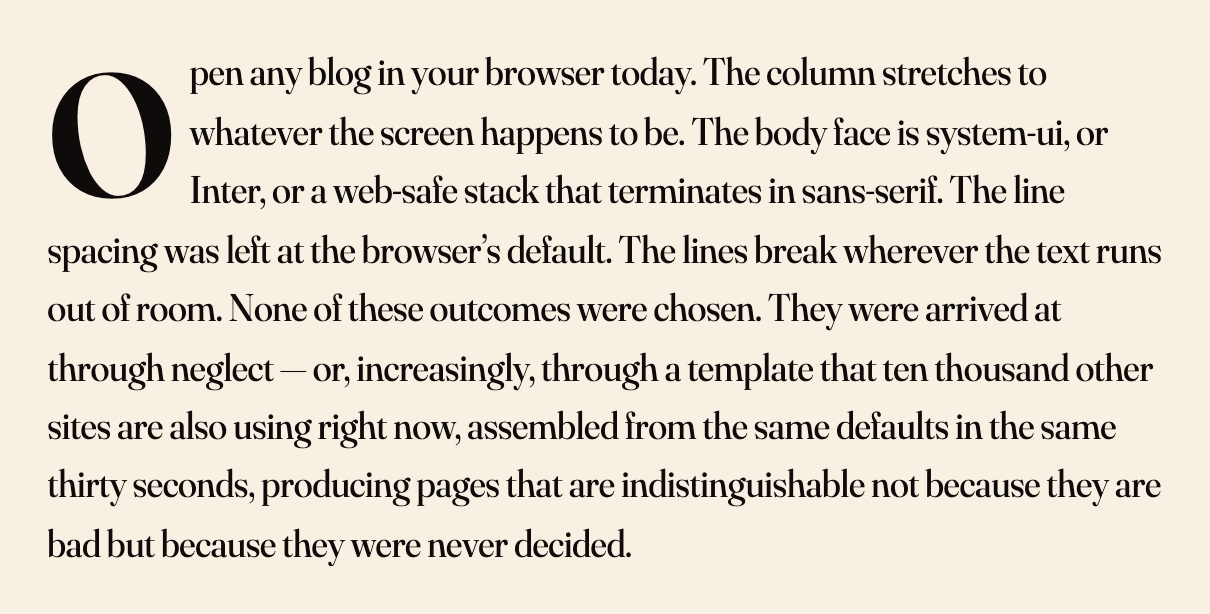
The same paragraph, twice.
Browser defaultSet by Pilcrow
Left: a system font, a column as wide as the window, lines broken
wherever the text ran out of room. Right: a drop cap, a
column held to a set measure, real hyphenation, every line ending
decided before the page loaded.
Read the whole essay, set the same way →
Seven pages, seven things to look for.
Every essay on this site is set by the engine you'd use. Each of
these shows one thing the web usually gets wrong.
Substack posts look like Substack posts. Medium articles look like
Medium articles. ChatGPT-written ebooks look like ChatGPT-written
ebooks. The visual signature of produced quickly, default-styled
has become a tell. Readers feel it before they can name it.
Your writing deserves better than that.
Then try it with your own words.
Paste a paragraph into the Playground. Pick a font. Watch Pilcrow
set it the way print does — drop cap, 65-character lines, real
en-gb hyphenation, balanced line endings.
No account. No download. The engine runs in your browser.
Canva gives you a layout — a poster, a deck, a brochure shell. The
text on it is whatever font you picked from a dropdown. That's
why a Canva carousel looks like a Canva carousel.
Pilcrow doesn't lay out the page; the page is the
layout. We set the type the way a printer would: drop cap on the
lede, 65-character lines, real hyphenation, sidenotes in the margin.
Every blog post, every page of a brochure, every chapter of a book
gets the same craft treatment.
You can spot a Canva piece in a feed. The point of Pilcrow is that
you can't spot ours — it just reads better.
Which one are you?
I write a blog or newsletter.
You want your writing to look like it's from The Atlantic,
not from a CMS template. Hosted blog at your own domain. Web
editor. Drop caps, sidenotes, real hyphenation. Set like a magazine.
Manuscript ready, but it doesn't look like a real book yet.
The Author plan takes your Markdown, Word, or Google Doc and
returns a print-ready PDF, an EPUB, and a typeset sample chapter.
The pipeline is built and tested; checkout opens with live
billing, and the waitlist hears first.
Brochures, thought-leadership PDFs, brand-led blogs. Output that
reads like £2,000 of editorial design, not like a Canva template.
Custom fonts, custom palette, and multi-author arrive with the
Business plan. Coming soon.
In Markdown, in our web editor, or by uploading your Word
document. The way you already work — we don't make you
learn a new tool.
2
Pilcrow sets it.
Our engine runs the same typesetting pipeline as a print
compositor: hyphenation dictionary, line-break optimisation,
drop-cap measurement, sidenote alignment. Build time, not
browser time.
3
Publish.
Your blog goes live at your domain. Your book becomes a
print-ready PDF and EPUB. Your brochure becomes a download. Set
once, ready everywhere.
Read other writers on Pilcrow Press.
The Pilcrow Press gallery is a curated directory of blogs,
newsletters, and brand publications typeset with Pilcrow. Every
entry is hand-picked. Click in to read; trace the typography back
to the engine.
The gallery opens in summer 2026 with the closed-beta cohort.
Want to be considered?
Join the waitlist.
Pricing
Free
MIT licensed · self-hosted
For developers running the engine themselves.
Pilcrow engine
Self-host anywhere
npx create-pilcrow
Writer
£12/mo
For the blog or newsletter that should look like yours.
All plans include our six-font shortlist (Fraunces, Newsreader,
Source Serif 4, EB Garamond, Inter, Spectral), drop caps, real en-gb
hyphenation, sidenotes, footnotes, pull quotes, OG cards, and RSS.
The engine doesn't change between tiers — only what surrounds it.
Annual billing saves ~30%. Cancel anytime. We don't lock you in
— your content exports as Markdown whenever you want it. Rows marked
soon switch on as each plan's checkout goes live; the
waitlist hears first.
Questions
Why not just use Substack, Medium, or Ghost?
Because Substack looks like Substack. Pilcrow sets your writing so
it looks like yours, not the platform's. If your
writing's voice matters, the typography should match it.
Is this only for English?
Today, yes — our hyphenation engine is en-gb. Other languages are
on the roadmap (CJK, Arabic, and Hebrew are tracked).
Can I use my own fonts?
The Business plan will take your licensed TTFs when it launches.
Today every plan uses our curated six-font shortlist (all
open-licensed, all editorial-grade).
Is the engine really open source?
Yes. MIT licensed, on npm as pilcrow-typeset. The paid
plans are about the SaaS surface (hosted blogs, the web editor,
custom fonts, support) — not about gatekeeping the engine.
I'm a developer. Can I skip the SaaS and run the engine myself?
Yes. npx create-pilcrow my-blog scaffolds a site on
the same engine — free, open source, MIT.
Start with the CLI on GitHub.
What about AI-written content?
We make AI-assisted writing look the way you'd want your own
writing to look. The engine doesn't care who wrote the words;
it cares that the page they sit on reads like it was set with
care. That visible care is what readers respond to.
Can I move off Pilcrow later?
Yes. Export your content as Markdown at any time — and as the
typeset PDF/EPUB once those formats ship. No lock-in.
Stop using the default.
Open the playground. Paste a paragraph. See your writing set the way
it should have been all along.